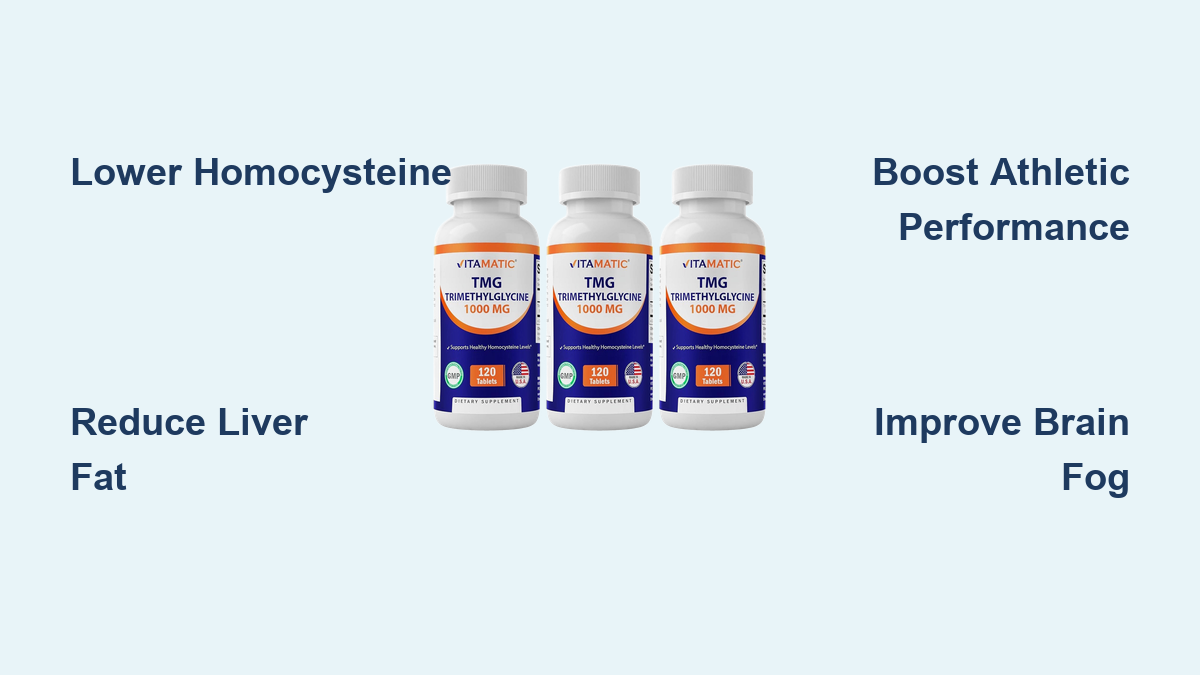

When your homocysteine levels stay stubbornly high despite taking B vitamins, TMG (trimethylglycine) supplementation often provides the missing solution. This naturally occurring compound, also known as betaine, functions as a powerful methyl donor that supports cardiovascular health, liver function, and athletic performance through unique biochemical pathways. While you can get small amounts of TMG from foods like spinach, beets, and broccoli, dietary intake typically ranges from just 0.5 to 2 grams daily—far below therapeutic levels used in clinical research. Understanding the specific TMG supplement benefits backed by science helps you determine if this targeted intervention aligns with your health goals. Decades of research confirm TMG’s effectiveness for homocysteine regulation, liver fat metabolism, and methylation support, making it a strategic supplement choice for specific health objectives.
Why TMG Outperforms B Vitamins for Homocysteine Control
TMG delivers superior homocysteine-lowering effects compared to B vitamins alone by activating the BHMT pathway—a critical methylation route that operates independently of folate and vitamin B12. Clinical studies consistently show that daily doses of 1.5 to 6 grams reduce homocysteine levels by 20-40% in individuals with elevated readings, even when standard B-vitamin protocols fail. This makes TMG particularly valuable for the 40% of people carrying MTHFR gene mutations that impair folate metabolism.
How TMG Targets Stubborn High Homocysteine
TMG works through a direct biochemical process where it donates three methyl groups to convert homocysteine into methionine—the essential amino acid your body needs for hundreds of critical functions. Unlike the folate-dependent pathway that requires multiple conversion steps, TMG’s action happens in a single enzymatic reaction primarily in your liver and kidneys. This streamlined process explains why TMG often produces faster homocysteine reductions in people who’ve seen limited results with methylfolate or B12 supplements alone.
Who Needs TMG for Homocysteine Management
You’ll likely benefit from TMG supplementation if:
– Your homocysteine remains above 8 µmol/L despite taking B vitamins
– You carry MTHFR C677T or A1298C genetic variants
– You take medications that interfere with folate metabolism
– You’re over 50 (natural methylation decline occurs with age)
– You experience symptoms like brain fog or fatigue linked to methylation issues
TMG’s Liver Fat Reduction Mechanism Explained

TMG supplementation significantly reduces liver fat accumulation in people with non-alcoholic fatty liver disease (NAFLD) by enhancing fat export processes through VLDL assembly. Research shows that taking 1.5-3 grams daily for 6-12 months lowers liver fat content by up to 30% while improving ALT and AST enzyme levels—key markers of liver inflammation. The compound works by donating methyl groups needed to convert phosphatidylethanolamine to phosphatidylcholine, a critical step in packaging triglycerides for removal from liver cells.
How TMG Fixes Fatty Liver in 3 Steps
-
Boosts VLDL production: TMG provides methyl groups essential for phosphatidylcholine synthesis, enabling your liver to properly assemble very-low-density lipoproteins that transport fat out of liver tissue
-
Enhances fat oxidation: By supporting SAMe production, TMG activates enzymes responsible for breaking down fatty acids in liver mitochondria
-
Reduces oxidative stress: TMG’s osmolyte properties protect liver cells from damage caused by fat accumulation and inflammation
For best results, combine 2 grams of TMG daily with 1,000-2,000 mg of omega-3 fatty acids and reduce refined carbohydrate intake—this triple approach addresses multiple pathways of fatty liver development.
Athletic Performance Gains from TMG Supplementation
Competitive athletes using 2.5 grams of TMG daily see measurable improvements in power output and endurance performance within 14 days of consistent use. The compound enhances exercise capacity through three distinct mechanisms: increasing cellular creatine stores for rapid ATP regeneration, reducing homocysteine buildup during prolonged activity, and maintaining optimal cellular hydration through its osmolyte function. Research documents 3-5% increases in bench press power and 5-7% longer time to exhaustion during cycling tests among TMG users compared to placebo groups.
Pre-Workout TMG Protocol for Maximum Gains
For strength athletes: Take 1.25 grams of TMG 45 minutes before training to maximize phosphocreatine availability during high-intensity sets. Pair with 5 grams of creatine monohydrate for synergistic effects on power output.
For endurance athletes: Consume 2.5 grams of TMG 60 minutes before activity to maintain homocysteine balance during prolonged efforts. In hot conditions, this protocol reduces perceived exertion by 10-15% according to cycling time trial studies.
Critical timing tip: Avoid taking TMG with high-dose antioxidants (like 1,000 mg vitamin C) immediately before workouts, as this may blunt the adaptive signaling responses to exercise.
Brain Fog Relief Through TMG’s Methylation Support

TMG crosses the blood-brain barrier to directly support neurotransmitter production and neuronal function, making it particularly effective for clearing brain fog linked to methylation deficits. Individuals with MTHFR mutations often experience dramatic cognitive improvements within 2-4 weeks of starting 1.5 grams daily, as TMG bypasses their impaired folate metabolism pathway to provide direct methyl group donation for dopamine, serotonin, and acetylcholine synthesis.
TMG’s Dual Action on Cognitive Function
TMG tackles cognitive issues through two complementary mechanisms:
-
Neurotransmitter production: By donating methyl groups for catechol-O-methyltransferase (COMT) activity, TMG helps regulate dopamine breakdown—critical for focus and executive function
-
Homocysteine reduction: Lowering elevated homocysteine protects against vascular cognitive impairment and preserves white matter integrity in brain imaging studies
For optimal cognitive benefits, take TMG in the morning with a B-complex supplement containing active B6 (P-5-P) and B12 (methylcobalamin), as these cofactors work synergistically in methylation pathways.
TMG Dosage Guidelines for Specific Health Goals
Your ideal TMG dosage depends entirely on your targeted health outcome, with research-supported ranges varying significantly across applications. For homocysteine management, 1.5-3 grams daily in divided doses provides maximum benefit without increasing side effect risk. Liver health protocols typically require 2-3 grams daily for 6-12 months to achieve measurable reductions in liver fat. Athletes seeking performance enhancement benefit from 2.5-6 grams daily, with 2.5 grams taken 30-60 minutes pre-workout delivering optimal results.
Avoid These Common TMG Dosing Mistakes
-
Starting too high: Begin with 500 mg twice daily for the first week to assess tolerance before increasing to therapeutic doses
-
Taking at wrong times: For cognitive benefits, take morning doses with breakfast; for athletic performance, time doses 30-60 minutes pre-exercise
-
Ignoring synergistic nutrients: Pair TMG with magnesium glycinate (200-400 mg) to enhance absorption and reduce potential stomach discomfort
Critical warning: Never exceed 6 grams daily without medical supervision—higher doses may cause gastrointestinal distress and potentially increase TMAO levels in sensitive individuals.
TMG Safety Profile and Side Effect Management
TMG demonstrates an excellent safety profile with minimal side effects at research-backed dosages (up to 6 grams daily), though approximately 15% of users experience mild gastrointestinal effects when starting supplementation. The most common issues include temporary bloating, gas, or loose stools—typically resolving within 7-10 days as your system adjusts. These effects are almost always dose-dependent, meaning you can prevent them by starting with 500 mg twice daily and gradually increasing over 2-3 weeks.
Who Should Avoid TMG Supplementation
Certain individuals should exercise caution or avoid TMG:
– People with trimethylaminuria (“fish odor syndrome”) may experience symptom exacerbation
– Those with severe kidney impairment (eGFR <30) should consult a nephrologist first
– Individuals scheduled for surgery should discontinue TMG at least 14 days pre-procedure
– People taking MAO inhibitors require medical supervision due to theoretical interactions
If you experience persistent side effects beyond two weeks, reduce your dose by 50% and take TMG with food—this simple adjustment resolves most tolerance issues while maintaining therapeutic benefits.
Best TMG Supplement Selection Criteria

Not all TMG supplements deliver equal value, with significant quality variations between products. When choosing a TMG supplement, verify these three critical factors: the label must specify “trimethylglycine” or “betaine anhydrous” as the active ingredient (not “betaine HCl”), contain at least 500 mg per serving for practical dosing, and display third-party testing certification from NSF, USP, or ConsumerLab. Avoid proprietary blends that obscure actual TMG content per serving.
Top 3 Quality Red Flags to Avoid
-
Betaine HCl confusion: Products labeled “betaine hydrochloride” target digestion, not methylation—ensure your supplement specifies “anhydrous” or “trimethylglycine”
-
Inadequate dosing: Capsules containing less than 500 mg require excessive pill-taking to reach therapeutic doses (1.5-3 grams)
-
Missing purity verification: Without third-party testing, products may contain heavy metals or fail to deliver labeled potency
The most cost-effective and flexible option is pure TMG powder, which allows precise dose titration and typically costs 30-50% less per gram than capsule alternatives. Mix 1.5 grams (approximately ½ teaspoon) with juice or smoothies to mask the naturally sweet but distinct flavor.
TMG supplementation delivers targeted benefits for specific health concerns with strong scientific backing for homocysteine management, liver fat reduction, and athletic performance enhancement. By selecting the right dosage for your goals and avoiding common implementation mistakes, you can harness TMG’s methylation-supporting power while minimizing potential side effects. Always pair TMG with a nutrient-dense diet and appropriate medical monitoring—particularly if managing elevated homocysteine or fatty liver disease. For most adults, 1.5-3 grams daily provides significant health advantages with minimal risk, making TMG a valuable addition to personalized wellness protocols when used strategically.